
Kudu Hunting
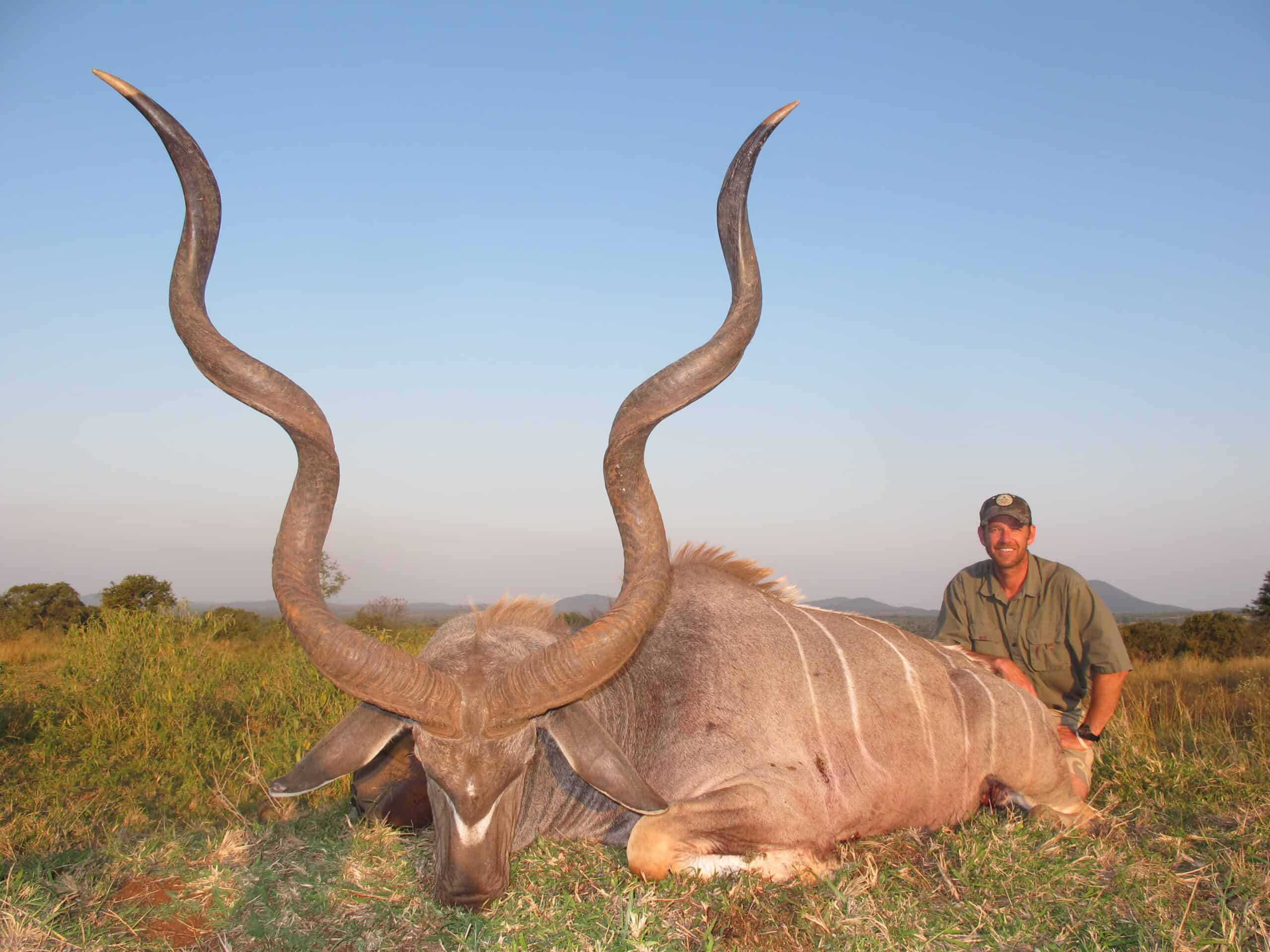
“No matter the angle, always make sure the bullet ends up between the two front legs.” – Jannie Stander, Graham Sales Safaris Professional Hunter
The Greater Kudu is one of Africa’s most iconic spiral-horned antelopes. Known as the “Grey Ghost,” it offers a challenging and rewarding plains game hunting experience that demands patience, precise shot placement, and expert guidance.
The Greater Kudu: The “Grey Ghost” of Africa
Ethical trophy hunting
At Graham Sales Safaris, we believe that understanding the heritage of your quarry is the first step toward an ethical and rewarding hunting experience. The Greater Kudu (Tragelaphus strepsiceros) is arguably the most iconic spiral-horned antelope in the world.
Often referred to as the “Grey Ghost” because of its ability to vanish into the thicket, a Kudu hunt is a bucket-list experience for any sportsman planning a plains game hunting trip to Africa.
The meaning behind the name
While many believe Tragelaphus translates to “spiral-horned,” its etymology is more ancient. It stems from the Greek words tragos for goat and elaphus for deer, literally meaning “goat-deer.”
The descriptive term for the spiral horns, strepsiceros, comes from strephis, meaning twisting, and keras, meaning horn. When you hunt with our experienced African Professional Hunters, you are not simply pursuing a trophy. You are engaging with a species whose taxonomic history dates back to Pallas in 1766 and which has been a cornerstone of African hunting for centuries.
Taxonomy and distribution
Subspecies and distribution: Where to hunt Africa’s best Kudu
When booking an African hunting Safari, it is important to know which subspecies you are pursuing. Graham Sales Safaris specializes in free-range and sustainable hunts across varied African habitats.
Cape Greater Kudu (T. s. strepsiceros)
Found in the Eastern Cape Province of South Africa. It is characterized by a black face, smaller body size, and shorter horns compared with its northern relatives.
Southern Greater Kudu (T. s. zambesiensis)
Inhabiting Southern and Central Africa, including Namibia, Botswana, and Zimbabwe, this is the giant of the species. It is the most sought-after Kudu for trophy hunting because of its massive body and long corkscrew horns.
East African Greater Kudu (T. s. bea)
Found in Tanzania, Kenya, and Uganda. This subspecies is brighter in colour and has fewer transverse stripes, typically six to eight.
Abyssinian Greater Kudu (T. s. chora)
Primarily found in the mountains of Ethiopia and Sudan. It occupies drier regions and has coloration that is intermediate between the East African and Western varieties.
Western Greater Kudu (T. s. cottoni)
The most westerly distributed subspecies, found in Chad and the Central African Republic. It features a very pale coat, which is a biological adaptation to its desert-like habitat.
The Lesser Kudu (Tragelaphus imberbis)
For hunters seeking a more specialized Africa hunting trip, the Lesser Kudu is a striking alternative. Found in the arid regions of East Africa, its name imberbis means “beardless” because it lacks the long throat hair found on its larger cousin.
The Lesser Kudu is approximately half the size of the Greater Kudu but features striking white throat patches and vivid orange legs.
Hunting the Greater Kudu with Graham Sales Safaris
As a premier African Safari Outfitter, we ensure that every Africa hunting trip is conducted with the highest level of professionalism. Our Professional Hunters focus on providing a world-class experience while maintaining the integrity of the wild.
Sustainable and ethical practices
It is legal to hunt Kudu and its subspecies in several African nations under strict conservation guidelines. At Graham Sales Safaris, we advocate for sustainable utilization, ensuring that trophy hunting contributes to the preservation of African wildlife and supports local communities.
Shot placement and caliber
Success on a plains game hunting expedition depends on preparation. Correct shot placement remains the most important factor for a clean and ethical harvest.
Preferred caliber: Although Kudu are large animals, they are not thick-skinned. We recommend rifles in the .30-caliber range, with the .300 Win Mag considered the best overall option.
Shot placement by Graham Sales: Aim for the “engine room” between the shoulders. For a broadside shot, place the bullet approximately one-third of the way up the body, directly in line with the front leg, to ensure a quick and ethical kill.
Professional Hunter guidance: “No matter the angle, always make sure the bullet ends up between the two front legs.” – Jannie Stander, Graham Sales Safaris Professional Hunter
Preferred caliber for Kudu
Kudu are large plains game animals, but they are not considered thick-skinned. Graham Sales Safaris recommends dependable rifles in the .30-caliber range.
Best overall caliber: .300 Win Mag.
Shot placement
A broadside shot should be placed approximately one-third of the way up the body, directly in line with the front leg. The objective is to place the bullet in the vital “engine room” between the shoulders for a quick and ethical harvest.
Always follow the guidance of your Professional Hunter, particularly when the animal is quartering or standing at an unusual angle.
Plan your plains game hunting Safari
Whether you are tracking through the thickets of Limpopo or the hills of the Eastern Cape, Graham Sales Safaris provides a professional, seamless, and authentic African hunting experience.
Ready to pursue the legendary Grey Ghost?
Contact Graham Sales Safaris today to book your next ethical African hunting Safari with some of the most experienced African Outfitters in the business.


